
Thrust roller bearings are the components engineers specify when a shaft pushes or pulls along its own axis and no radial bearing can carry the load. Whether the application is a vertical pump, a gearbox input shaft, a crane hook, a rolling mill screwdown, or a rotary table, the axial force has to travel from the shaft into the housing through rolling elements designed for exactly that direction of load. Choosing the wrong type shows up later as spalling, overheating, or a seized assembly long before the maintenance interval is due. This guide explains how thrust roller bearings carry axial loads, how the main designs differ, and what to verify before specifying one.
How Thrust Roller Bearings Carry Axial Load
All rolling bearings manage load through contact between rolling elements and raceways. The defining characteristic of a roller thrust bearing is line contact: cylindrical, spherical, tapered, or needle rollers touch the raceway along a line rather than at a single point. That geometry distributes the axial force across a much larger contact area, which is why roller thrust bearings tolerate far higher axial loads than thrust ball bearings of the same envelope.
The trade-off is speed and misalignment tolerance. Higher contact pressure and sliding motion between roller ends and the guiding surfaces limit permissible speed, and most thrust roller designs cannot accept shaft deflection or housing tilt. They also generally cannot carry radial load on their own, so they are usually paired with a radial bearing in the same assembly.
Cylindrical Roller Thrust Bearings
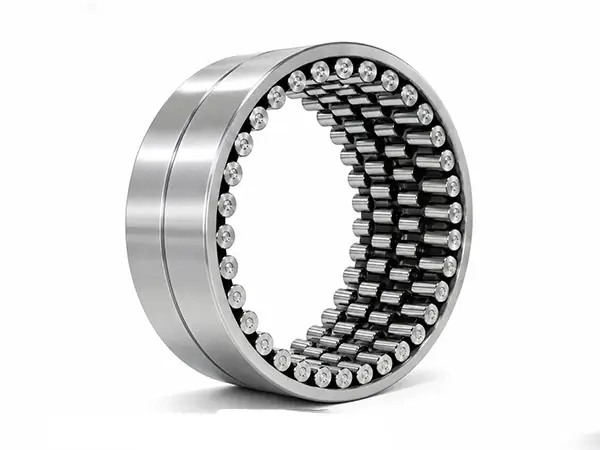
These consist of a shaft washer, a housing washer, and a cage with cylindrical rollers arranged radially. They are made in single-direction and double-direction versions, with flat or spherical seating surfaces. Cylindrical roller thrust bearings offer very high axial stiffness in a relatively thin axial section, making them a common choice for machine tool tables, extruder thrust blocks, and vertical shaft arrangements. They require good parallelism between the shaft and housing seats and offer no self-aligning capability.
Spherical Roller Thrust Bearings
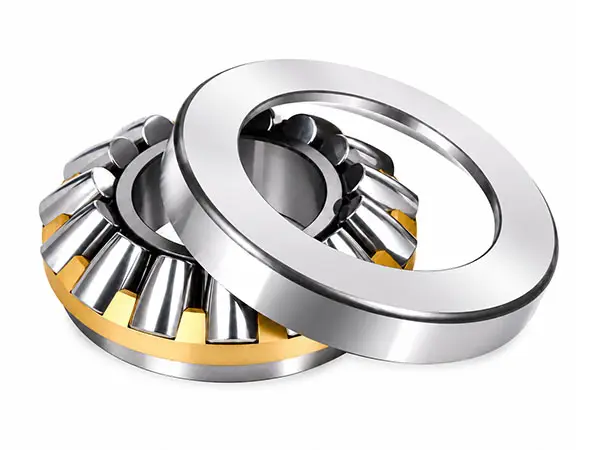
Also called self-aligning roller thrust bearings, this design uses barrel-shaped rollers running on a spherical raceway in the housing washer. The arrangement permits angular misalignment of the shaft relative to the housing, which is essential in applications where deflection or mounting inaccuracy is unavoidable. Because the rollers are inclined relative to the axis, spherical roller thrust bearings can carry combined axial and radial loads, with radial capacity typically a fraction of the axial rating. They are widely used in vertical pumps, marine gearboxes, and pulp and paper machinery.
Tapered Roller Thrust Bearings
With tapered rollers and conical raceways, these bearings handle very heavy axial loads and, in several series, substantial radial loads at the same time. They are common in rolling mill screwdowns, crane hooks, and heavy gearbox applications. Many types are separable, which simplifies inspection, and some are supplied as matched sets to control preload and load sharing.
Needle Roller Thrust Bearings
When axial space is the limiting factor, needle roller thrust bearings and thrust washers provide high load capacity in a very small section height. They are typically used where a radial bearing already occupies most of the available housing, leaving only a few millimeters for axial support.
Selecting the Right Bearing for the Axial Load
Bearing selection is a sequence of elimination, not a guess based on bore size. Work through the following factors in order, because each one can rule out entire families of bearings.
- Load magnitude and direction. Establish the maximum continuous axial load and the peak transient load, including shock. If the bearing must also carry radial load, verify the ratio of radial to axial force against the specific catalogue rating rather than assuming any thrust roller bearing will do.
- Misalignment requirement. If shaft deflection, thermal growth, or housing distortion will tilt the washers, a self-aligning design is mandatory. Flat-seated cylindrical roller thrust bearings will edge-load and fail early under the same conditions.
- Speed. Rotational speed determines lubrication regime and heat generation. Roller thrust bearings generally run slower than thrust ball or angular contact bearings of comparable size.
- Available axial space. Section height frequently decides between a needle, cylindrical, and spherical design.
- Lubrication method. Oil bath, circulating oil, grease, or oil mist. Thrust bearings depend on a continuous film; oil feed is normally directed at the contact zone.
- Preload and stiffness. Precision machine tool and instrument applications may require controlled preload, which affects the cage and washer configuration selected.
Advantages Over Alternative Axial Load Solutions
- Much higher axial load capacity than thrust ball bearings within the same bore and envelope.
- Higher axial stiffness, which reduces deflection under load and improves positioning accuracy.
- Better resistance to shock and impact loading than point-contact designs.
- Spherical and tapered types can carry combined axial and radial loads, sometimes removing the need for a second bearing.
- Needle configurations allow very compact axial assemblies.
- Separable designs simplify mounting, inspection, and replacement.
Mounting, Lubrication, and Operating Limits
Most premature thrust bearing failures trace back to installation and lubrication rather than to the bearing itself. Observing a few fundamentals extends service life considerably.
- Confirm that the shaft and housing washers are seated squarely and that seating surfaces meet the flatness and parallelism specified for the design.
- Apply the correct fit. A thrust washer that rotates with the shaft needs an interference fit; a stationary housing washer does not.
- Maintain adequate minimum axial load on spherical roller thrust bearings during operation, since insufficient load allows rollers to skid.
- Use lubricant with the correct viscosity for the operating temperature and speed, and keep it clean. Contamination is the leading cause of surface damage.
- Provide a defined oil path so the contact zone receives a continuous supply, and give the housing room for oil to drain.
Common Failure Modes and What They Indicate
Reading a damaged bearing correctly usually reveals the real problem in the machine.
- Spalling concentrated on one side of the raceway points to misalignment or a non-square seating surface.
- Smearing and skidding indicate insufficient minimum load or inadequate lubrication at low speed.
- Overheating and discoloration suggest excessive preload, wrong lubricant viscosity, or insufficient clearance.
- Fatigue flaking across the whole raceway means the axial load simply exceeds the bearing rating and a larger or higher-capacity design is required.
- Fretting on the washer bore suggests a loose fit allowing micro-motion on the shaft.
Frequently Asked Questions
Can a thrust roller bearing carry radial load?
Cylindrical and needle roller thrust bearings are intended for axial load only and should not be used to support radial forces. Spherical and tapered roller thrust bearings can carry combined loads, but the radial capacity is limited and must be checked against the specific catalogue rating for the size and series.
Why does my thrust bearing run hot?
The usual causes are insufficient lubrication or an incorrect lubricant, excessive preload, inadequate axial clearance, or misalignment causing edge loading. Verify the lubrication supply first, then check seating flatness and the actual load condition.
When should a thrust ball bearing be replaced by a roller thrust bearing?
When the axial load exceeds the practical range of a ball thrust bearing, when higher axial stiffness is needed, or when shock loading is present. If speed is the dominant requirement and loads are light, a ball design may still be the better answer.
Working With a Bearing Supplier
Thrust roller bearings are not interchangeable by bore size alone. The correct specification depends on the load case, misalignment conditions, speed, lubrication, and the geometry of the surrounding assembly. CHG Bearing supports engineers through that process by matching application data to the right bearing type, confirming load ratings and fits, and supplying documentation for verification. Sending a short description of the application, the axial and radial load values, the speed, and a sketch of the mounting arrangement is usually enough to get an accurate recommendation rather than a generic substitute. Getting that step right at the specification stage costs far less than replacing a failed bearing during a shutdown.