Unplanned downtime rarely announces itself. A failed spherical roller bearing on a conveyor drive or a worn cylindrical roller bearing inside a gearbox can stop production within minutes, and the spare on the shelf often carries a different part number than the one that failed. Interchange — substituting one manufacturer's roller bearing for another's — is a daily reality for maintenance teams, and it is also where expensive errors begin. Two bearings that share identical boundary dimensions can still differ in internal clearance, cage material, tolerance class, or lubrication features. This guide walks through the checks that turn a risky guess into a documented, repeatable decision your team can defend.
Why Interchange Is a Maintenance Skill, Not a Lookup Task
Most maintenance teams start an interchange by typing a bearing number into a search box and accepting the first cross-reference that returns. That approach works only when the substitute is a true dimensional and functional equivalent. In practice, bearing numbering systems are proprietary to each manufacturer, and they encode information that a cross-reference table cannot fully capture.
ISO 15 defines the boundary dimensions — bore, outside diameter, and width — for roller bearings. It does not define internal geometry, cage design, heat treatment, or clearance. That is why a 22220 EK and a 22220 CC/W33 can both fit the same housing and shaft, yet behave very differently under shock load, misalignment, or high temperature. Interchange is therefore a specification exercise, not a search exercise.
Decoding the Bearing Number Before You Cross-Reference
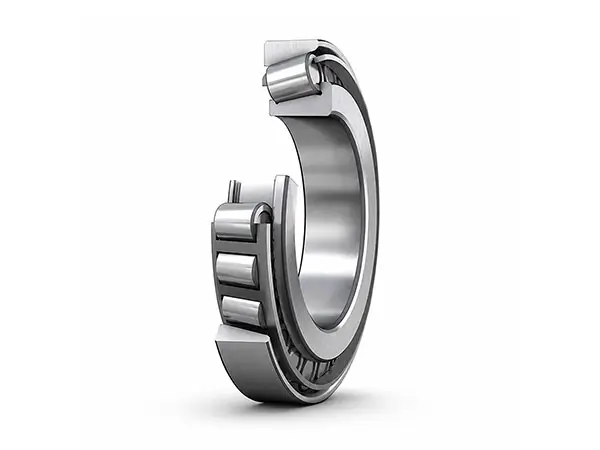
The first discipline is separating a basic designation from a complete designation. The basic designation tells you the bearing type and dimension series. Everything after it is a modification that may or may not matter for your application.
Basic Designation: Type and Dimension Series
In a number such as 22314, the leading digits indicate the bearing type (spherical roller bearing with symmetrical rollers), the next digits indicate the width and diameter series, and the final two digits give the bore in millimetres for bore sizes up to 480 mm. Two bearings with the same basic designation are dimensionally interchangeable by definition. Two bearings with different dimension series are not, regardless of what a generic cross-reference suggests.
Suffixes Carry the Critical Information
Suffixes are where interchange failures hide. Common examples include:
- Clearance groups — CN, C2, C3, C4, C5. A C4 bearing is not a drop-in replacement for a CN bearing in a normal-fit application.
- Bore type — K for tapered bore, with or without an adapter sleeve.
- Cage designation — E, CC, MB, J, TN9, and similar codes describe pressed steel, machined brass, or polyamide cages.
- Lubrication features — W33 for an annular groove and three lubrication holes; W513 or similar for other configurations.
- External features — N or NR for snap ring grooves, which affect axial location in the housing.
- Tolerance class — P6, P5, or P4 per ISO 492, which governs running accuracy and speed capability.
Before you accept any cross-reference, confirm that every suffix on the original bearing is either matched or deliberately replaced with a documented reason.
A Step-by-Step Interchange Workflow for Maintenance Teams
A repeatable process prevents the same mistake from recurring across shifts and sites. The workflow below is suitable for both emergency substitutions and planned standardisation projects.
- Record the complete original designation, including all suffixes, plus the manufacturer name from the bearing face or box.
- Measure the failed bearing if the markings are worn — bore, outside diameter, width, and, for tapered bore bearings, the taper ratio.
- Document the application conditions: speed, load type, misalignment, operating temperature, lubrication method, and mounting arrangement.
- Obtain at least two candidate cross-references and compare their complete designations, not just their basic numbers.
- Verify internal clearance against the original specification and the actual fit on the shaft and in the housing.
- Check the load rating and limiting speed of the candidate against the original. A lower rating is not automatically disqualifying, but it must be justified by a calculation.
- Record the approved interchange in your CMMS or spare parts master so the next technician does not start from zero.
Interchange Comparison Checklist: What to Verify
The items below are the ones that most often decide whether a substitution succeeds or fails. Treat each as a pass/fail check rather than a judgement call.
- Boundary dimensions: Identical bore, outside diameter, and width. This is necessary but never sufficient.
- Dimension series: A different series may fit but will change load capacity and stiffness.
- Internal clearance: C3 is not a universal upgrade. Clearance must suit the fit, thermal gradient, and speed.
- Cage and roller guidance: A polyamide cage behaves differently from a machined brass cage under shock or elevated temperature.
- Tolerance class: Higher precision classes may be needed for high-speed or low-vibration applications.
- Sealing and lubrication: Sealed or greased-for-life variants change relubrication intervals and housing design.
- Load rating and limiting speed: Always compare the dynamic rating, static rating, and thermal reference speed.
- Mounting hardware: Adapter sleeves, withdrawal sleeves, and lock nuts are not always interchangeable between brands.
Where a candidate fails one of these checks, the correct action is to keep searching or consult a specialist — not to install and observe.
Common Interchange Mistakes to Avoid
Most failures traced back to interchange follow a small number of patterns. Reviewing them with your team is a low-cost form of training.
- Matching only the basic number. This is the single most common error. The suffixes decide the outcome.
- Assuming higher clearance is safer. Excessive clearance reduces load zone coverage and can accelerate fatigue and vibration.
- Ignoring the housing fit. A substitute with a slightly different outside diameter tolerance can spin or creep in the housing.
- Reusing damaged sleeves and nuts. Worn mounting hardware introduces runout the new bearing cannot compensate for.
- Skipping documentation. Undocumented substitutions guarantee that the same question returns during the next breakdown.
Where a Bearing Specialist Adds Value
Even a disciplined team eventually meets a bearing that no published cross-reference resolves — a discontinued series, an obsolete cage design, or a machine built overseas with non-standard dimensions. At that point, the useful partner is one who can work from measurements and application data rather than from a catalogue table alone.
CHG Bearing supports maintenance and reliability teams with interchange verification, dimensional confirmation, and traceable documentation for roller bearing replacements, so the approved substitute can be recorded and repeated. For teams standardising across multiple lines, consolidating roller bearing ranges with a supplier who can explain the differences between designations is often more valuable than chasing the lowest unit price.
Frequently Asked Questions
Can I replace a C3 bearing with a CN bearing in an emergency?
Only if the original fit and thermal conditions genuinely call for normal clearance. In most roller bearing applications where C3 was specified, the clearance was chosen for a reason — interference fit, temperature differential, or speed. Installing CN clearance reduces the operating clearance further and can lead to premature failure. Use it as a temporary measure only, and log the substitution for review.
Is a cross-reference from one brand always valid for another?
No. Brand cross-references typically map basic designations and boundary dimensions. They rarely confirm internal clearance, cage material, tolerance class, or lubrication features. Always compare complete designations before approving a substitution.
How often should interchange records be reviewed?
Review them whenever an application changes — new load conditions, different lubricant, or a change in operating temperature. A substitution that was correct five years ago may no longer match the current duty cycle.
Final Thoughts
Roller bearing interchange rewards preparation. Teams that record complete designations, verify clearance and cage design, and document every approved substitution spend less time reacting to repeat failures and more time on planned work. The difference between a safe interchange and a costly one is rarely the bearing itself — it is the discipline applied before the bearing is installed.