Dust is not a nuisance for roller bearings — it is a wear mechanism. In mining, cement, aggregate, agricultural and steel plants, airborne particles smaller than a grain of sand enter bearing housings, mix with grease, and turn a smooth raceway into an abrasive grinding surface. The seal is the only barrier between that environment and the rolling elements, which is why seal choice often matters more than bearing brand in dusty applications. This guide compares the seal types commonly fitted to roller bearings, explains where each one works and where it fails, and sets out the selection criteria that keep equipment running between planned shutdowns.
Why the Seal, Not the Bearing, Decides Service Life in Dust
A roller bearing running in a clean, well-lubricated housing can reach its calculated L10 life without difficulty. The same bearing in a quarry conveyor or a cement kiln fan rarely gets there. In practice, most premature roller bearing failures in dusty plants trace back to contamination rather than fatigue.
The damage sequence is predictable:
- Fine particles pass the seal and enter the grease cavity.
- Particles migrate into the raceway contact zone and act as an abrasive third body.
- Surface roughness increases, film thickness collapses, and local stress risers form.
- Spalling, cage wear and overheating follow, often within a fraction of the expected service life.
Particle size determines how much damage a given ingress rate causes. Particles in the 5 to 20 micron range are the most destructive for roller bearings, because they are small enough to enter the contact ellipse but large enough to bridge the lubricating film. Coarse grit tends to be blocked by almost any seal; it is the respirable fraction that a seal must be designed to stop.
The Main Seal Types Used on Roller Bearings
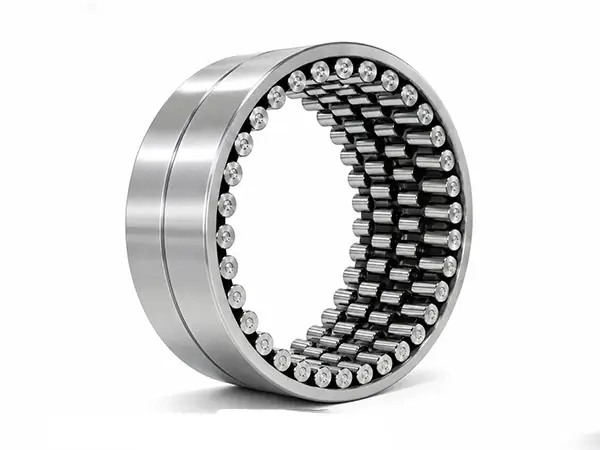
There is no universal best seal. Each design trades sealing efficiency against friction, speed capability, tolerance to misalignment and cost. Understanding those trade-offs is what allows a maintenance engineer to specify the right barrier for a specific machine.
Contact Lip Seals
Elastomer lip seals — typically nitrile rubber (NBR), hydrogenated nitrile (HNBR) or fluoroelastomer (FKM) — press a flexible lip against a ground shaft or wear sleeve. They offer the lowest leakage and the best exclusion of fine dust among single-element seals, which is why they remain the default on plummer block housings, gearbox shafts and many mounted bearing units.
Their limitation is friction. Lip pressure and sliding speed generate heat, and surface speed above roughly 10 to 15 m/s accelerates lip wear unless the compound and lip geometry are specifically engineered for it. A lip seal also requires a smooth, concentric counterface; running on a scored shaft destroys the seal in weeks.
V-Ring Seals
A V-ring is an all-rubber axial seal that stretches onto the shaft and seals against a perpendicular housing face. Because the sealing lip deflects rather than presses, friction is low and the seal tolerates shaft misalignment, thermal growth and relatively high speeds. V-rings are widely used on conveyor pulleys, crushers and fan shafts where a housing face is available.
Their weakness is that they are a single-stage, largely non-contact barrier. They deflect coarse dust and splash effectively, but airborne fines can still migrate past the lip in high-concentration environments. V-rings work best as the outer stage of a multi-stage system rather than as the only defence.
Labyrinth Seals
Labyrinth seals create a tortuous, non-contact path of alternating clearances that drops particle velocity and forces dust to change direction repeatedly. Because there is no rubbing contact, there is no wear, no speed limit from friction, and no heat generation — which makes labyrinth seals ideal for high-speed, high-temperature roller bearing positions such as kiln trunnion rolls, large fans and mill pinions.
The trade-off is clearance. A labyrinth must be assembled with precise axial and radial gaps, and it provides little protection against liquid or when the bearing sits in a strongly negative pressure zone that pulls air through the gap. Grease-packed labyrinths, where the grooves are filled with grease to trap particles, substantially improve performance in dry dust.
Felt and Friction Seals
Felt seals remain common in older or low-speed equipment. They are inexpensive, absorb oil and filter out coarse particles, but they hold abrasive dust against the shaft, wear the seating surface and offer limited protection against fines. Where an upgrade path exists, replacing felt with a lip or labyrinth arrangement is one of the highest-return reliability changes available.
Hybrid and Multi-Stage Sealing
Serious dusty-environment designs rarely rely on a single element. A typical high-reliability arrangement combines an outer V-ring or labyrinth that rejects bulk dust with an inner lip seal that excludes the residual fines, often with a grease purge between the stages. The intermediate grease chamber continually expels contamination and is one of the most effective measures available for roller bearings operating in heavy dust.
Seal Comparison at a Glance
- Contact lip seal: best fine-dust exclusion and lowest leakage; higher friction, needs a smooth concentric counterface and a defined speed limit.
- V-ring seal: low friction, tolerant of misalignment and thermal movement, easy to retrofit; limited fine-dust exclusion on its own.
- Labyrinth seal: no wear, no speed limit, excellent for high temperature and high speed; sensitive to assembly clearance and less effective against liquids.
- Felt seal: low cost and simple; wears the shaft and performs poorly against respirable dust.
- Multi-stage hybrid: highest protection level for severe dust; higher cost, greater axial length and more careful assembly.
Selection Criteria for Dusty Applications
Peripheral shaft speed
Above roughly 10 m/s, contact lip seals need low-friction compounds, reduced lip interference or replacement by a labyrinth or V-ring arrangement. Speed is usually the first filter in the selection process.
Particle size and concentration
Coarse, heavy grit requires a robust outer deflector. Fine, airborne dust — cement, fly ash, limestone powder — demands a contact or greased labyrinth stage. In very high concentrations, only multi-stage sealing with a grease purge delivers acceptable life.
Temperature and chemical exposure
Standard NBR handles roughly -30 to 100 degrees Celsius. Above that, HNBR or FKM is required. Steam, acid mist or aggressive washdown chemicals also rule out many standard elastomers and push the selection toward FKM or a non-contact labyrinth.
Lubrication method
Oil-lubricated roller bearings require a positive sealing strategy to prevent oil loss as well as dust entry. Grease-lubricated bearings tolerate simpler seals and can use the grease itself as a sealing medium when a purge path is designed in.
Misalignment and maintenance access
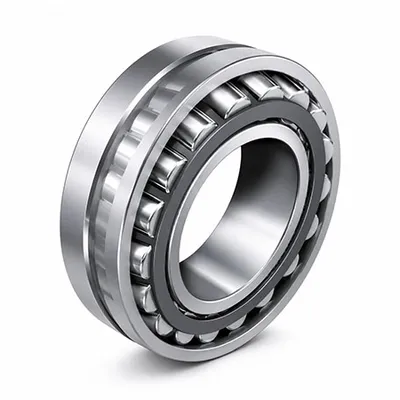
Self-aligning spherical roller bearings often run with some shaft deflection. A seal that cannot follow that movement will open a gap on one side. V-rings and labyrinth seals accommodate misalignment better than rigid lip seals, and they are also faster to replace during shutdowns.
Installation and Maintenance Practices That Extend Seal Life
- Protect the counterface. A scored or pitted shaft surface will destroy a new lip seal quickly. Use a wear sleeve where the shaft condition is marginal.
- Lubricate the lip before assembly. Dry installation burns the lip and creates an immediate leak path.
- Respect axial clearance. Labyrinth and V-ring seals fail when they are compressed against a face or left with excessive gap.
- Use the correct grease fill and re-greasing interval. Over-greasing blows seals out; under-greasing lets contamination concentrate in the raceway.
- Inspect seals at every planned stop. A hardening, cracking or displaced seal is a leading indicator of bearing failure, not a cosmetic issue.
Frequently Asked Questions
Is a labyrinth seal better than a lip seal in dust?
Not universally. A labyrinth seal wins on speed, temperature and wear-free operation; a lip seal wins on fine-dust exclusion and liquid containment. In severe dust, the strongest solution combines both in a staged arrangement.
How often should seals be replaced?
Replace seals whenever a bearing is replaced, whenever the shaft surface is reworked, and whenever inspection shows hardening, cracking, lip damage or axial displacement. Reusing an old seal on a new bearing is a common and avoidable cause of repeat failure.
Can a seal be added to an existing bearing housing?
In many cases yes. V-rings and wear-sleeve lip seal kits can be retrofitted to standard plummer blocks and mounted units without machining, which makes them a cost-effective reliability upgrade for existing conveyors and fans.
Summary
Choosing the best seals for roller bearings in dusty environments comes down to matching the barrier to the threat: particle size, concentration, shaft speed, temperature and lubrication method. Contact lip seals deliver the tightest exclusion, V-rings offer low-friction tolerance to misalignment, labyrinth seals provide wear-free protection at high speed and temperature, and multi-stage hybrids with a grease purge handle the most aggressive conditions found in mining, cement and aggregate plants.
CHG Bearing supplies roller bearings and matched sealing solutions for dusty industrial applications, helping maintenance teams specify the right combination of seal type, elastomer and housing arrangement rather than replacing bearings on a fixed calendar. Reviewing seal selection alongside bearing specification is one of the most reliable ways to extend service intervals and reduce unplanned downtime.