
Backing Bearings
High-Precision Support Bearings for Multi-Roll and Sendzimir MillsBearing Type:Backing Bearings
Application:Multi-roll and Sendzimir mills
Structure:Type 1 / Type 2 / Type 3
Rotation Accuracy:P4 or higher
Dimensional Accuracy:P5 or higher
Tolerance Groups:3–6 groups
Key Specifications
| Specification | Details |
|---|---|
| Bearing Type | Backing Bearings |
| Application | Multi-roll and Sendzimir mills |
| Structure | Type 1 / Type 2 / Type 3 |
| Rotation Accuracy | P4 or higher |
| Dimensional Accuracy | P5 or higher |
| Tolerance Groups | 3–6 groups |
| Group Difference | 3–5 μm |
| Maximum Rolling Speed | Up to 1000 m/min |
| Height Group I | 0 to −0.005 mm |
| Height Group II | −0.005 to −0.010 mm |
| Height Group III | −0.010 to −0.015 mm |
| Lubrication | Emulsion, circulating oil or oil mist |
| Sealing | Open, gap seal or rotary oil seal |
Backing Bearings Overview
Backing bearings are specialized support bearings developed for multi-roll and Sendzimir mills. Their thick-walled outer rings run directly as backing rolls on stationary support shafts, supporting the work-roll system in the rolling of steel, stainless-steel and non-ferrous strip.
Rolling force from the work rolls is transmitted through the backing bearings, support shafts and saddle system to the mill stand. Depending on the selected structure, the bearing can carry very high radial loads and may also accommodate axial loads transferred by the mill arrangement.
High Precision and Matched Height Groups
Uniform outer-ring running height is critical to strip quality and load sharing. CHG backing bearings are manufactured to high rotational and dimensional accuracy, then sorted into matched cross-section-height groups for installation on the same shaft.
- Rotation accuracy P4 or higher
- Dimensional accuracy P5 or higher
- Three to six selectable tolerance groups
- Group difference controlled to 3–5 μm
Thick-Walled Outer Ring and Load Transfer
The specially thick outer ring provides the stiffness and contact surface required to act as a backing roll. The inner assembly runs on a stationary support shaft, while the outer ring transmits rolling forces reliably to the support and mill-stand system.
- High radial load capacity
- Rigid thick-walled outer ring
- Axial load capability depends on structure
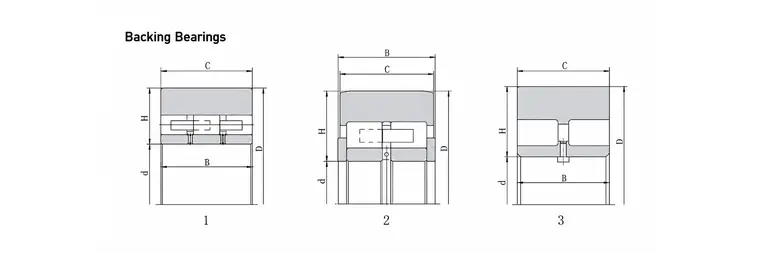
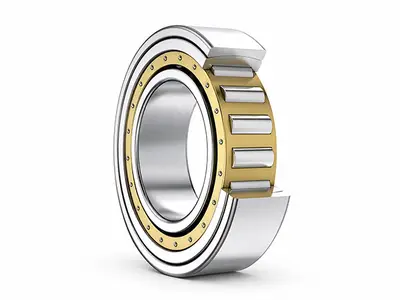
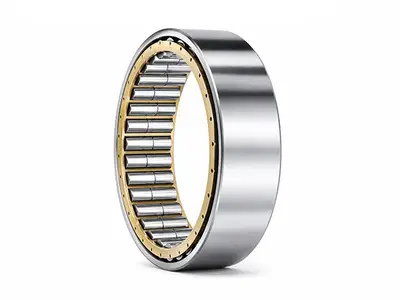
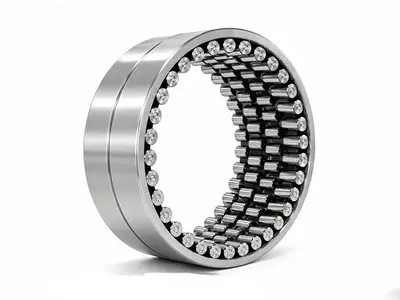
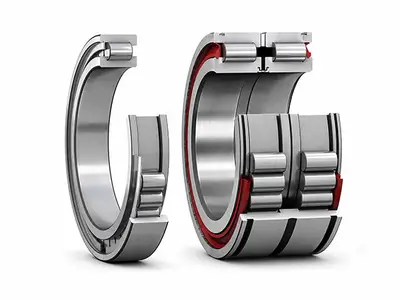
Three common backing-bearing structures: Type 1, Type 2 and Type 3
Bearing Structure Types
| Type | Configuration | Features and Lubrication |
|---|---|---|
| Type 1 | Ribless outer ring; first and second roller rows guided by double-claw cages; third row guided by a single-row solid cage | Axial guidance by movable retaining rings; circulating-oil lubrication |
| Type 2 | Double-row rollers; outer ring with three ribs; double-claw brass cage | Suitable for multiple lubrication methods; sealed or open design |
| Type 3 | Double-row full-complement design; center ribs on inner and outer rings | Open, unsealed design suitable for emulsion lubrication |
Lubrication, Sealing and Performance
Emulsion lubrication is economical and suitable for open bearings but requires high flow because of its low viscosity. Circulating oil is commonly used with sealed designs. Oil-mist or air-oil lubrication creates slight positive pressure to help exclude contaminants. Gap seals and rotary oil seals are available according to the mill environment.
Maximum rolling speed :Up to 1000 m/min
Typical Applications
- Multi-roll strip mills
- Sendzimir mills
- Steel-strip rolling lines
- Stainless-steel strip mills
- Non-ferrous strip rolling
- Precision thin-sheet, foil and straightening lines