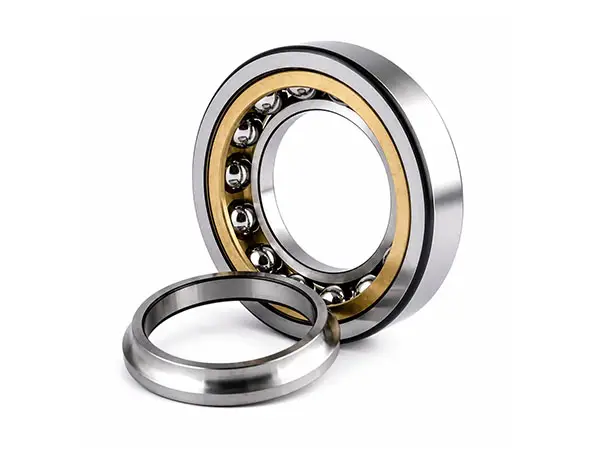
Four-Point Contact Ball Bearings
Compact Separable Bearings for Bidirectional Axial Loads and MomentsBearing Type: Four-Point Contact Ball Bearing
Size Range: d 150-480 mm; D 225-870 mm; 5.1-470 kg
Design Types: QJ and QJF
Contact Angle: Usually 35 degrees
Load Capacity: Radial load, bidirectional axial load and moment load
Separability: Separable bearing.
Technical Specifications
| Specification | Details |
|---|---|
| Bearing Type | Double Row Angular Contact Ball Bearing |
| Bore Diameter | 100-340 mm |
| Contact Angle | Usually 40 degrees |
| Primary Load | Radial-dominant combined radial and axial load |
| Axial Load | Bidirectional |
| Moment Load | Capable of carrying tilting moments |
| Locating Function | Bidirectional axial location |
| Separability | Non-separable |
| Material | Chrome steel or stainless steel |
| Lubrication | Grease or oil |
| Sealing | Sealed or open |
Four-Point Contact Ball Bearings Overview
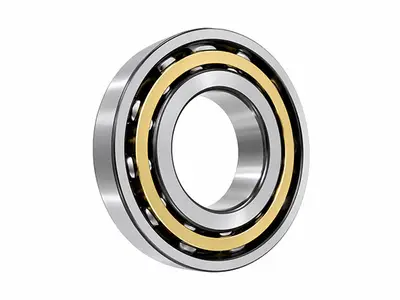
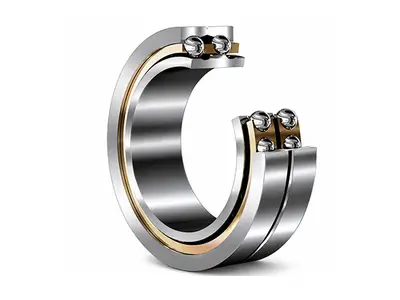
A four-point contact ball bearing is a single row angular contact ball bearing with a split inner ring or split outer ring. Its separable construction supports paired installation characteristics, carries axial loads in both directions and limits axial displacement in both directions while occupying less axial space than a double row angular contact bearing of the same size.
QJ designs use a split inner ring, while QJF designs use a split outer ring. The contact angle is generally 35 degrees. The bearing can carry radial load, bidirectional axial load and a certain moment load, combining functions associated with single row and double row angular contact ball bearings.
Four-Point and Two-Point Contact Mechanism
Under pure radial load, each ball contacts the raceways at four points. Under pure axial load, contact changes to two points, enabling axial load capacity in either direction. For high-speed operation, the bearing must run with a stable two-point contact condition.
- Four-point contact under pure radial load
- Two-point contact under pure axial load
- Bidirectional axial load capacity
- High-speed operation requires two-point contact
Compact Capacity and Easy Assembly
The split-ring design allows more balls to be installed, increasing load capacity while keeping the axial envelope compact. Installation and removal are convenient, and the bearing can provide bidirectional axial location together with radial and moment-load support.
- Smaller axial envelope
- More balls and higher load capacity
- Convenient installation and removal
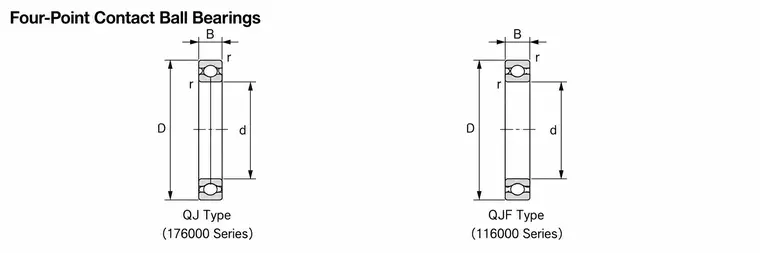
Four-point contact ball bearing QJ and QJF structures
Technical Specifications
| Type | Series | Structure and Selection |
|---|---|---|
| QJ Type | 176000 Series | Split inner ring with one-piece outer ring |
| QJF Type | 116000 Series | Split outer ring with one-piece inner ring |
Operating and Selection Considerations
Select the QJ or QJF arrangement according to the required separable ring, mounting sequence and shaft-housing layout. For high-speed duty, maintain the intended two-point contact through suitable clearance, fit and load control. Temperature capability depends on ring, rolling-element, cage, seal and lubricant configuration.
Typical contact angle : 35 degrees
Typical Functions and Arrangements
- Bidirectional axial locating positions
- Radial-load bearing positions
- Bidirectional axial-load supports
- Combined-load bearing arrangements
- Moment-load support positions
- Compact alternatives to double row designs